
February 2026
Click the link above to read the 2nd Edition of the Recovery Dharma book, including updates to the text and 14 personal stories of recovery from members of the community!
Dear Sangha,
We are now into the second month of 2026, and hopefully this year has started off with an upswing if need be? What did 2025 hold that we want to let go of? How has, or can, letting go of these cravings alter experience as the year and its individual moments unfold?
In January we started a monthly observance of first the Four Noble Truths followed by the Eightfold Path. With February we can reflect upon the cause of our suffering: craving.
There are of course the necessities of food, water, shelter & Sangha. Our book says other craving, “replaces compassion, kindness, generosity, honesty and other intentions that might have been there.” Do you see this play out in your experiences? In what way can we let go of our craving, and use more of our energy to the path? We don't have to move mountains, but, helping others climb that otherwise could not is a good start.
Peace & Harmony,
RD Denver
Sangha Spotlight
Mike
He/Him
1. How did you find Recovery Dharma?
I went to a Refuge Recovery meeting in New Orleans in 2017 mostly to prove a friend wrong. At the time, I was convinced 12-Step was the only way to stay sober. I already had a vipassana practice, but I was pretty narrow‑minded about recovery. That meeting ended up changing my entire attitude about what recovery could be like. When I got back to Pittsburgh, I helped start the city’s first two Refuge Recovery meetings with a few friends from AA. After the split from the founder of Refuge Recovery, we continued on with Recovery Dharma.
2. Had you been introduced to the Buddha's teachings before?
No. To be honest, even Recovery Dharma was a hard sell. I am fairly averse to organized religion. It wasn't until I learned of the extraction of the experiential teachings that I decided to give it a chance. I'm grateful that others, like Stephen Batchelor, have come before me to lay the groundwork for a fulfilling secular practice. I don't need to call myself a Buddhist to work Recovery Dharma or to practice the Buddha's teachings. I can simply run the experiment countless others of run by practicing what the Buddha taught and see if that helps me in my life.
3. Do you mix in any other practices with your recovery?
Funny you should ask! I am part of a group called Raft Recovery here in Denver (search for us on Meetup) and we are blending the 12 steps with a Buddhist practice. In my experience, it's very much the work, service, and sangha that are the secret sauce. It's been a great experience getting back into 12-Step from a Buddhist perspective where "turning it over" isn't the solution. I occasionally also attend other Buddhist-based recovery meetings and events through the Buddhist Recovery Network (https://buddhistrecovery.org/).
4. Is there anything in particular from the Dharma (teachings), the Sangha (community), meditations or any other aspect that resonates with you in your day to day life?
There's a great story of the Buddha talking to his cousin and assistant, Ananda, who posits that perhaps sangha is half of the path. The Buddha corrects him saying sangha is the whole of the path. I have found this with my recovery: service and community have been paramount. I've made great friends and have had amazing experiences in recovery. They helped me learn a new way of living and I'm grateful for that. I've truly "woken up," as they say.
5. Is there anything you would want to share with someone new to recovery or new to the Dharma?
I celebrated 17 years clean and sober on January 28 and I thank you all for being a part of it. I tried for years to figure it out on my own and within only a few weeks others taught me how to do it right. AA helped get me sober and RD and a Buddhist practice has added even more. So thank you!
Buddhist Celebrations
this month
(*celestial events are added as particularly in Theravadan Bhuddism, the lunar cycles are part of the cyclical nature of existence. These days may be incorporated within your own personal practice.)
February 2nd
🌕 Full Moon
February 15
Parinirvana Day (Mahayana, Feb 15) or Parinibbana Day (Theravada, Feb 27) is a Buddhist holiday celebrated mostly in East Asia, Vietnam and the Philippines. It is to commemorate the passing away of the Shakyamuni Buddha when he attained complete nibbana or Parinibbana. )
The day serves as a reminder of the transformative potential within individuals to attain enlightenment and contribute to the well-being of all sentient beings.
February 16
🌑 New Moon
Upcoming Events
To have your Dharma and/or recovery events added to the newsletter, please email recoverydharmametrodenver@gmail.com.
Inquiries Group at the Phoenix Gym (2221 Champa St., Denver, CO 80205)
Sundays, 6:45PM (except first Sunday of each Month reserved for business meeting).
Come and do your Inquiries with us! Whether just Starting on the first, picking up where you've left off or if you've done them before to understand how responses may have changed in time. We may be on different ones. What matters is that we come together for ourselves and to support others on the jouney.
Each meeting is facilitated by somebody new. Maybe yourself?
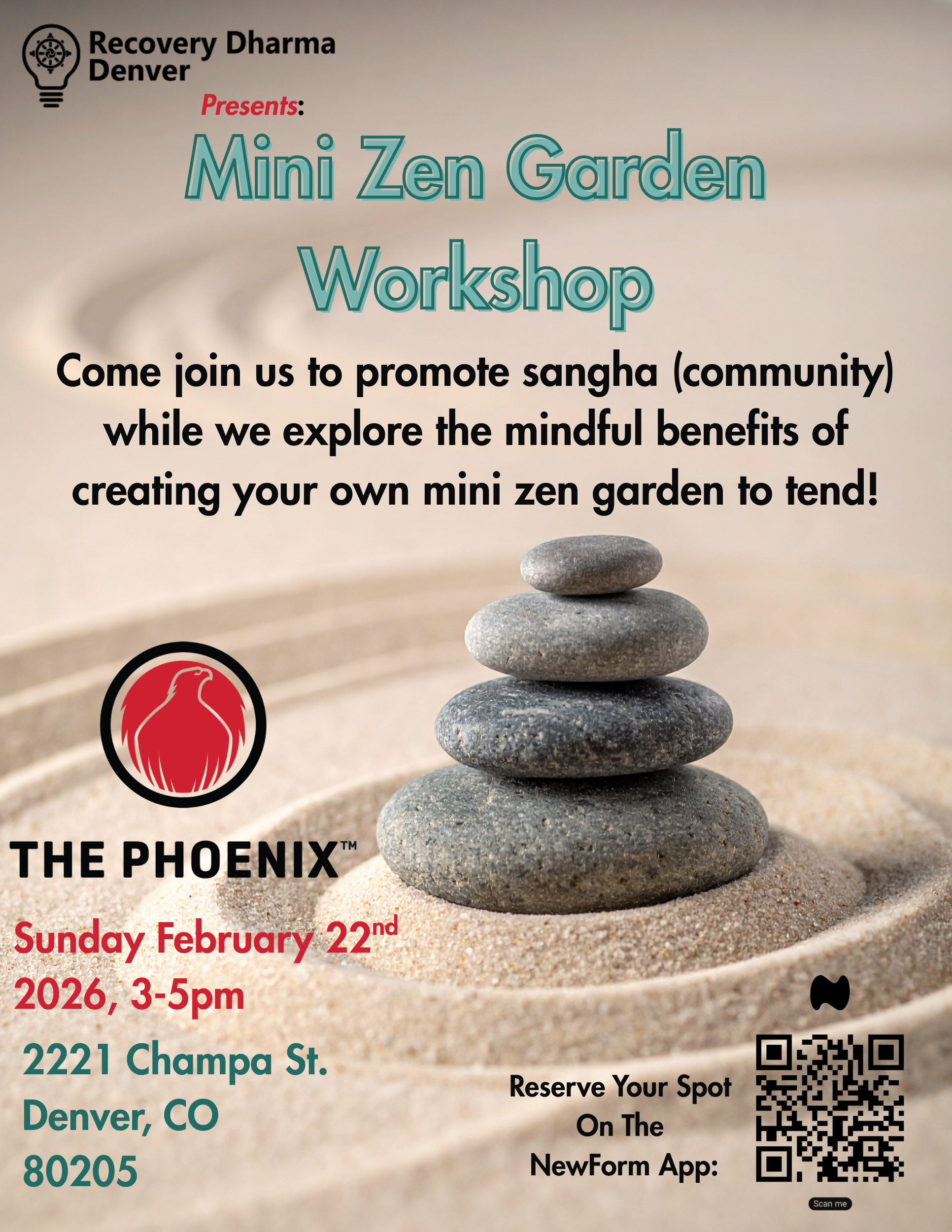
Phoenix Sangha Social
Zen Garden Workshop
Sunday, February 22, 3-5PM
2221 champagne St., Denver, CO 80205
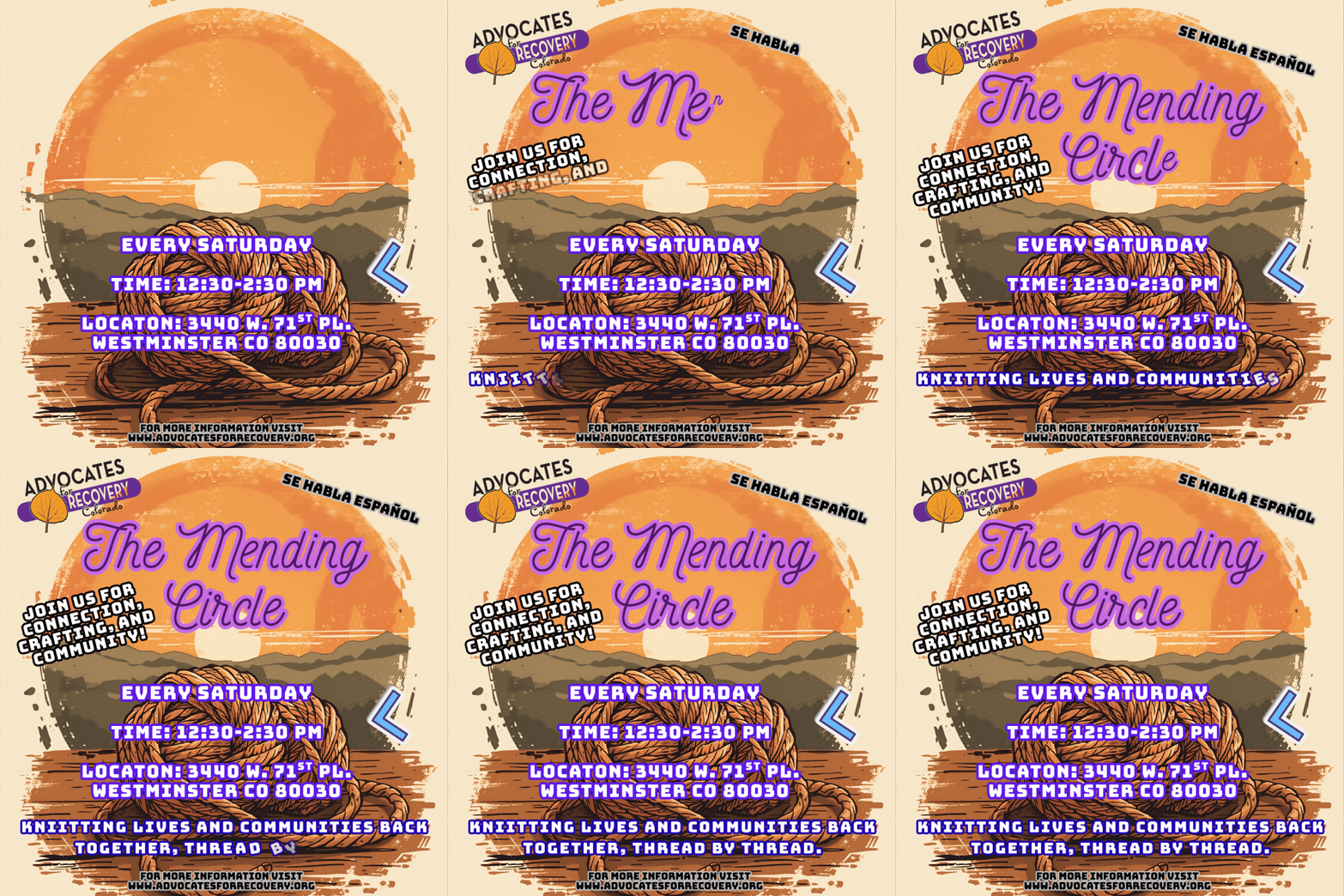
The Mending Circle
Saturday, February 7
12:30 PM 2:30 PM
Advocates for Recovery Colorado 3440 W. 71st PlaceWestminsterUnited States
This isn't just a hobby group-it's a mission. Our goal is to spend the year creating handmade hats, scarves and blankets. In the upcoming winter, we will host an outreach event to distribute these items to individuals in our community experiencing homelessness, providing much-needed warmth during the Colorado winter.
For more events with AFR click here.
Colorado Artists in Recovery (CAiR) hosts several workshops throughout the month, and welcomes all in recovery to participate for free. Whether you are new in recovery or wanting to try something new well into your journey, these workshops offer wonderful opportunities to explore new talents and meet others within positive/safe spaces.
Hatha Yoga flow for mindfulness and wellness.
Sunday, February 8th, 15th & 22nd 3:00-4:00PM
Champa Street Gym
2233 Champa Street, Denver, CO
Please reserve a spot ahead of time on the NewForm app.
For a full listing of events at the Phoenix Gym, click here.
Meetings
Join us at one of our weekly meetings. We have in-person meetings nearly every day of the week across the Front Range as well as online meetings you can join from anywhere. We practice meditation together and then read from the Recovery Dharma book or another Buddhist text. The second half of the meeting is dedicated to providing space to talk about the topic or anything you need to share related to recovery.
Sundays 5:30 The Phoenix (In-Person) 2233 Champa St. Denver, CO 80205
Tuesdays 6:45 The Phoenix (In-Person) 2233 Champa St. Denver, CO 80205 (in Baby Champa, the door to the left of the gym entrance).
Thursday 6:30 pm MT Lakewood (In-Person) @ Shepherd of the Hills Church - 11500 W 20th Ave, Lakewood, CO 80215
Thursday 7:00 pm MT Denver (In-Person) @ FREE Spiritual Community Center - 2122 S. Lafayette St, Denver, CO 80210
For a complete list of meetings in the area, visit our website. To have your Dharma group added to our list, please reach out at RecoveryDharmaMetroDenver@gmail.com.
From the Book
THE SECOND NOBLE TRUTH:
The Cause of Suffering
As people who have become dependent on substances and behaviors, we’ve all experienced the sense of failure and hopelessness that comes from trying, and failing, to let go of our fixations. Addiction itself increases our suffering by creating a hope that both pleasure and escape can be permanent. We go through this suffering again and again because substances or behaviors can only give us temporary relief to our pain, our unhappiness, and our lost or damaged sense of self.
Our refusal to accept the way things are leads to wanting, or craving, which is the cause of suffering. This excludes discrimination-based suffering and harm which do not need to be “accepted” but met with wise boundaries, wise action, and compassion. We don’t suffer because of the way things are, but because we want — or think we “need” — those things to be different. We suffer because we cling to the idea that we can satisfy our own cravings, while ignoring the true nature of the world around us. Above all, we cling to the idea that we can hold on to impermanent and unreliable things, things that can’t ever lead to real satisfaction or lasting happiness, without experiencing the suffering of one day losing them.
Clinging to impermanent solutions for suffering results in craving. We experience craving like a thirst, an unsatisfied longing, and it can become a driving force in our lives. If craving goes beyond simple desire, which is a natural part of life, it often leads us to fixation, obsession, and the delusional belief that we can’t be happy without getting what we crave. It warps our intentions so that we make choices that harm ourselves and others. This repetitive craving and obsessive drive to satisfy it leads to what we now know as addiction. Addiction occupies the part of our mind that chooses — our will — and replaces compassion, kindness, generosity, honesty, and other intentions that might have been there. Many of us experience addiction as the loss of our freedom to choose; it’s the addiction that seems to be making our choices for us.
Read this and the rest of the book here. This starts on page 13.
Community Resources
Recovery Dharma supports a holistic path to recovery. There is no one right way to recover and it's always a good idea to add more tools to your toolbox to facilitate your healing.
Here are some other community resources to check out:
Advocates for Recovery - recovery meetings, events, coaching
CHOW (Culinary Hospitality Outreach and Wellness)
CAIR (Colorado Artists in Recovery) - artists workshops and events
Rooted303 - personal development classes, recovery coaching, support groups
The Phoenix - A Sober Active Community offering free exercise classes
Hard Beauty - recovery coaching and workshops
Meditation Resources - Insight Timer App, Sounds True One, Waking Up, Headspace, Plum Village App, Recovery Dharma Meditations.
Recoverydharmametrodenver@gmail.com
Powered by Squarespace
