
January 2026

Click the link above to read the 2nd Edition of the Recovery Dharma book, including updates to the text and 14 personal stories of recovery from members of the community!
Dear Sangha,
As we begin into the new year, this is an opportunity to reflect while looking ahead. Where did we connect, where did we not connect? Where were we wise, where were we not?
This is a great time to refresh our understanding of the Truths and our Path. The Four Noble truths are 1. There is suffering, 2. There is a cause to our suffering, 3. There is a way to end our suffering and 4. There is a path that leads to the end of suffering. Our Eightfold path as follows is divided into three groups. There is the Wisdom group: 1. Wise Understanding and 2. Wise Intention. There is the Ethics group: 3. Wise Speech, 4. Wise Action and 5. Wise Livelihood. Then finally the Concentration group: 6. Wise Effort, 7. Wise Understanding and 8. Wise Concentration.
We are all on our unique paths; we are also deeply interconnected. The Truths are as such. Each of these are unique within themselves. This uniqueness has greater depth when they are put together. The Path is no different. Like the aspen trees of Colorado they stand alone above ground. Examine below and you'll find they are connected by an interlocking system of roots. This is where they gain much of their nutrients.
With four Truths, 8 folds within the Path and 12 months in the year this provides an opportunity to examine one a month. Whether new in recovery or in periods of further exploration, how do you observe “suffering”? How can this understanding help in decreasing the suffering we experience? As always, please be kind to yourself.
Peace & Harmony,
RD Denver
Sangha Spotlight
Stephen
He/Him
1. How did you find Recovery Dharma?
I was introduced to Recovery Dharma while I was in residential treatment. Members from a local sangha were kind enough to bring the meeting there. The practice of meditation and a new path in recovery was very appealing to me.
2. Had you been introduced to the Buddha's teachings before?
I read about them when I was younger but had never really explored them. I do remember I preferred those ideas over Western practices.
3. Do you mix in any other practices with your recovery?
I utilize NA, ACoA, and therapy with Recovery Dharma practices.
4. Is there anything in particular from the Dharma (teachings), the Sangha (community), meditations or any other aspect that resonates with you in your day to day life?
My main takeaway from Recovery Dharma is it has really helped me explore the spiritual aspect of my recovery. I also appreciate that nowhere does it state that that this path is the only path. It adds to, not replaces, my other programs.
5. Is there anything you would want to share with someone new to recovery or new to the Dharma?
When you begin your journey in recovery, be open to any and all pathways. The only correct solution is the one that works for you, not necessarily what works for others. I'm grateful I was introduced to Recovery Dharma, it added a new element to my recovery I was lacking and I'm stronger today because of it.
Buddhist Celebrations
this month
Mahayana New Year (January 3)
The Mahayana New Year on the 3rd January 2026, marks the beginning of the New Year for many Buddhists who follow the Mahayana tradition, one of main branches of Buddhism. The Mahayana New Year coincides with the first full moon of the first month. It is a period to focus on reflection, renewal, and setting positive intentions for the year ahead. Rather than a single-day event, the Mahayana New Year is often observed over several days. Common practices include meditation, making offerings, and acts of generosity and compassion. This time also encourages us to reflect on ethical living, mindfulness, and respect for others. The Mahayana tradition emphasises liberation through compassion to help all others to reach enlightenment. (Source: blogs.manchester.ac.uk)
Supreme Reflection Day (January 11)
As the main practice day in the waning period of the moon, it is Supreme Day of Reflection day for quiet and meditation, especially for Akshobhya Buddha and the Vajra Family who represent the practice of the wisdom of Mirror-Like Reflection: “Mind like a Sheet of Water” or the moon reflected in still water. This wisdom overcome the poison of Anger.
Akshobhya Buddha’s Dharani — very profoundly powerful for purifying not only your own negative karma and obstacles but also that of friends or family or ancestors who passed away, and animals who are suffering or passed away. (Source: buddhaweekly.com)
Supreme Renewal Day (January 18)
The last day of the lunar month, or New Moon, is very auspicious and has high merit for all practices but it is especially the day for purifying all the negative karma of the previous month for a fresh start on the new month. Especially important for Mahayana Buddhists is Vajrasattva’s 100-syllable mantra, which purifies all negative karmas. (Source: buddhaweekly.com)
Upcoming Events
To have your Dharma and/or recovery events added to the newsletter, please email recoverydharmametrodenver@gmail.com.
Inquiries Group at the Phoenix Gym (2221 Champa St., Denver, CO 80205)
Sundays, 6:45PM (except first Sunday of each Month reserved for business meeting).
Come and do your Inquiries with us! Whether just Starting on the first, picking up where you've left off or if you've done them before to understand how responses may have changed in time. We may be on different ones. What matters is that we come together for ourselves and to support others on the jouney.
Each meeting is facilitated by somebody new. Maybe yourself?
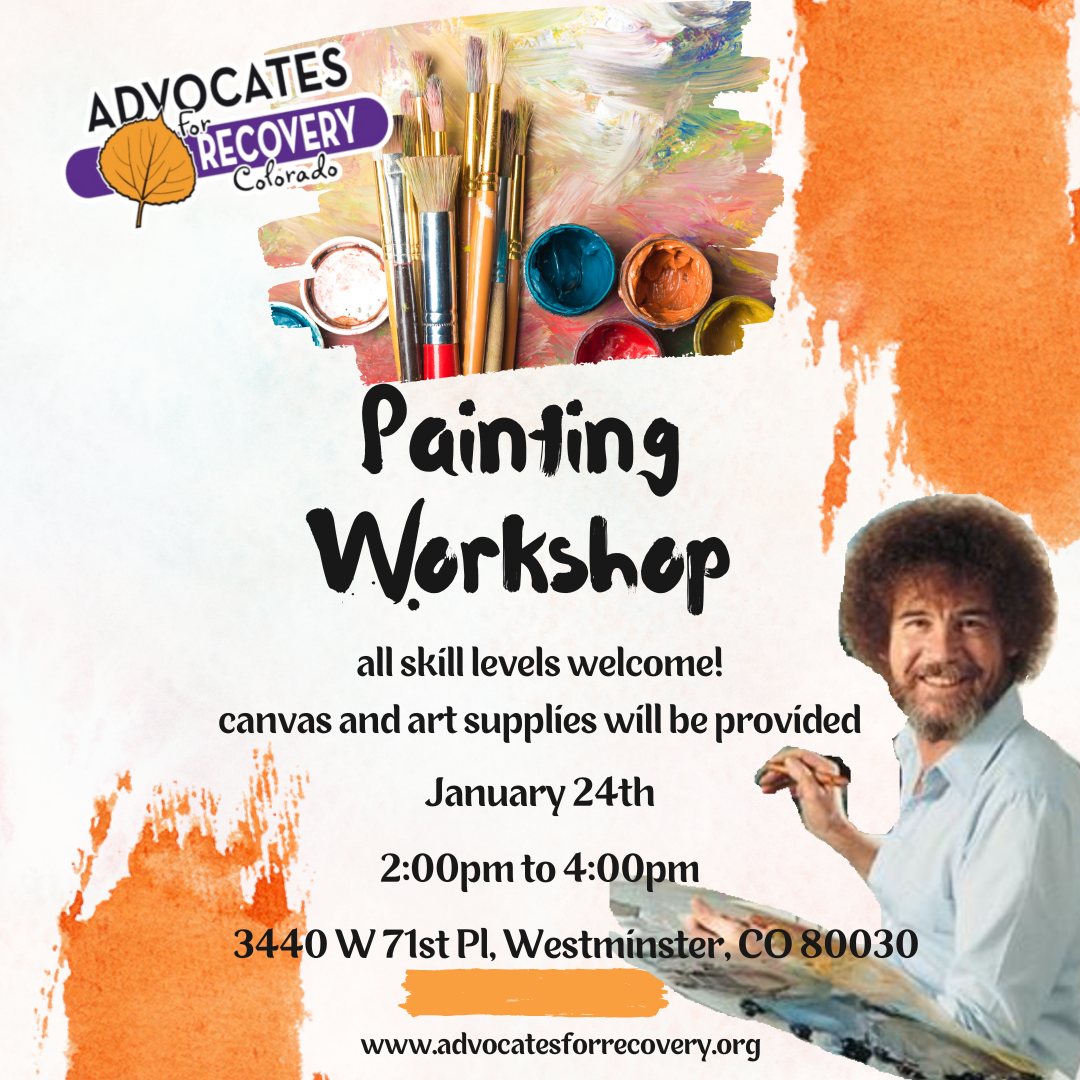
Paint With Bob
Saturday, January 25
2:00 PM 4:00 PM
Advocates for Recovery Colorado 3440 W. 71st PlaceWestminsterUnited States
Come celebrate the joy of being creative with Advocates For Recovery! This workshop is open to all skill levels, including beginners! Let’s connect with others walking their path of recovery as we all collectively flex our artistic muscles and CREATE! All are welcome! Register Here.
For more events with AFR click here.
Colorado Artists in Recovery (CAiR) hosts several workshops throughout the month, and welcomes all in recovery to participate for free. Whether you are new in recovery or wanting to try something new well into your journey, these workshops offer wonderful opportunities to explore new talents and meet others within positive/safe spaces.
Mindfulness Monday Drawing
Monday, January 12 6:00-8:00PM
Champa Street Gym
2233 Champa Street, Denver, CO
Mindful Monday Drawings is a low-pressure, guided drawing session focused on presence, observation, and creative grounding. Through simple prompts and quiet drawing exercises, participants are invited to slow down, reconnect with their bodies, and engage with drawing as a mindful practice rather than a performance. All skill levels are welcome. This is a judgment-free space with no critiques and no expectation to create a finished piece. The focus is on process, reflection, and showing up as you are. Produced by AQUI, a Phoenix program and sober creative community.
Please reserve a spot ahead of time on the NewForm app.
For a full listing of events at the Phoenix Gym, click here.
Meetings
Join us at one of our weekly meetings. We have in-person meetings nearly every day of the week across the Front Range as well as online meetings you can join from anywhere. We practice meditation together and then read from the Recovery Dharma book or another Buddhist text. The second half of the meeting is dedicated to providing space to talk about the topic or anything you need to share related to recovery.
Sundays 5:30 The Phoenix (In-Person) 2233 Champa St. Denver, CO 80205
Tuesdays 6:45 The Phoenix (In-Person) 2233 Champa St. Denver, CO 80205 (in Baby Champa, the door to the left of the gym entrance).
Thursday 6:30 pm MT Lakewood (In-Person) @ Shepherd of the Hills Church - 11500 W 20th Ave, Lakewood, CO 80215
Thursday 7:00 pm MT Denver (In-Person) @ FREE Spiritual Community Center - 2122 S. Lafayette St, Denver, CO 80210
For a complete list of meetings in the area, visit our website. To have your Dharma group added to our list, please reach out at RecoveryDharmaMetroDenver@gmail.com.
From the Book
THE FIRST NOBLE TRUTH:
There is Suffering
Some of the ways in which we may experience suffering are obvious, like poverty, hunger, pain, disappointment, and feeling separated or excluded. There is also suffering due to the divisions of our world, such as war, colonization, and oppression. Some are less obvious, like feelings of cravings, anxiety, stress, and uncertainty. We also suffer as we struggle with birth, aging, sickness, and death. As much as we want to avoid what we consider unpleasant and hold onto what we label as pleasant, dissatisfaction, separation, loss, and injustice still may frequently arise. Suffering occurs whenever we fail to see the true nature of our existence, when we insist on controlling or altering our reality.
The First Noble Truth rests on the understanding that our lives seem unsatisfactory because experiences are impermanent and impersonal. Our senses (which the Buddha understood to include not just hearing, seeing, smelling, tasting, and touch, but also thinking) are often unreliable and temporary, which means that the way we experience and make sense of the world is constantly changing and subjective. We suffer because we keep expecting these temporary experiences to be permanent and absolute, and to satisfy our craving for pleasure or to avoid pain.
Read this and the rest of the book here. This starts on page 8.
Community Resources
Recovery Dharma supports a holistic path to recovery. There is no one right way to recover and it's always a good idea to add more tools to your toolbox to facilitate your healing.
Here are some other community resources to check out:
Advocates for Recovery - recovery meetings, events, coaching
CHOW (Culinary Hospitality Outreach and Wellness)
CAIR (Colorado Artists in Recovery) - artists workshops and events
Rooted303 - personal development classes, recovery coaching, support groups
The Phoenix - A Sober Active Community offering free exercise classes
Hard Beauty - recovery coaching and workshops
Meditation Resources - Insight Timer App, Sounds True One, Waking Up, Headspace, Plum Village App, Recovery Dharma Meditations.
Recoverydharmametrodenver@gmail.com
Powered by Squarespace
